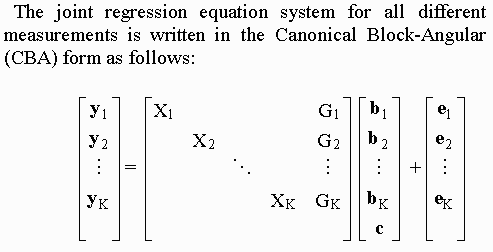
The answer:
"It has turned out that:
In 1880, Professor R. F. Helmert (1841-1917) specified the underlying
mathematical problem through formulating the sparse Canonical Block-Angular (CBA)
equation system for GEODETIC data.
In 1960, the equation system and formulae for solving positions of MOVING objects
were disclosed under the title of Kalman Filtering (KF).
In 1969, a computing method for solving COMMON factors and (Canonical) Correlations between (two)
blocks of data by using Empirical Orthogonal Functions (EOF) was reported by Lange (1969).
In 1972-75, the sparse CBA equations for balloon tracking systems were reported and
solved ANALYTICALLY by Lange.
In 1978, Professor Helmut Wolf (1910-1994) published his analytic formulas
for a blockwise solution of Helmert's Normal Equations (NEQ).
In 1982, an exact formula for computing the ACCURACY of
the Helmert-Wolf blocking (HWB) solution was published by Lange (1982).
In 1986, the HWB solution was GENERALIZED to other applications by Lange (1987).
In 1989, the CONNECTION between the HWB solution and fast Kalman Filtering (FKF) was discovered and patented by Lange (1990).
In 1992, the FKF method was applied to EXTENDED Kalman Filtering (EKF) by Lange (1993).
In 1995, the FKF method was extended to ADAPTIVE Kalman Filtering (AKF) by Lange (1997).
By 2015, all these FKF patents expired.
In 2020, RTK From the Sky
Brings Instant GNSS (cm) Accuracy Worldwide;
the good old global Precise Point Positioning (PPP) becomes now
the most precise satellite-based Real Time Kinematic (RTK) navigation
by exploiting, at last, my Fast Kalman Filtering (FKF) to solve
those computational challenges that otherwise, i.e. if using ordinary
Kalman Filetering (KF), would require inverting correlation matrices
of impossibly large sizes. "
The answer:
"Not reaally! The FKF method may though to be circumvented
by using a furiosly faster processor.
However, this could not happen even at any serious increase of
computing power as almost
indefiniteley long decimal numbers would also be requiered
without FKF.
The battery of a light-weight low-powered device should also be
many times larger for equal high-performance-computing (HPC).
Thus, FKF is a killer application now as the serious
competition in both accuracy and reliability
begins in all markets of navigation, mobile positioning, ultra-reliable guidance,
autonomous vehicles, etc."
The answer:
"FKF renders the most effective computational method for updating
calibration parameters that stem as integration constants
from the differential equations of signal-phases and acceleration
measurements in HYBRID systems.
The optimality of the FKF computations is necessary for reliable
accuracy estimation that can now be obtained as a byproduct from
the sophisticated theory of Minimum Norm Quadratic Unbiased Estimation
(MINQUE)
by C. R. Rao (1975).
Superb accuracies and integrity are thus achieved in real-time only by using the
Statistical Calibration
by Lange (1999)."
The answer:
"International GNSS Services provide precise orbital solutions
for realtime application.
The Helmert-Wolf Blocking (HWB) solution method is applied
to the realtime products
of meteorological data-assimilation like that from the European
Centre for Medium-Range Weather Forecasts
(ECMWF).
Embedded microchips based on hybrid navigation concepts are
being developed..."
The answer:
"KF renders the theoretically best method for updating estimates
of unknown parameters when new data flow continuously into
a navigation receiver or control system.
Thus, all navigation receivers must make use of a Kalman Filter.
However, there still are certain absolutely
necessary conditions for these
filtering processes to be absolutely RELIABLE.
The main problem with any large common KF solution stems from the fact
that it cannot take into account that many of its numerous calibration parameters are mutually uncorrelated by definition. Thus, the covarince matrices to be exactly inverted become overly large for any optimal KF solution. "
The answer:
"One of the reliability conditions of any Kalman Filter is that the inflow of data must continuously
contain enough information on all those parameters whose values must be estimated.
In other words, if a KF tries to estimate the value of a parameter under
circumstances when the inflowing data has very little to do with this parameter
then its estimated value is doomed to go astray sooner or later.
The FKF-method represents the Best Available Technology (BAT) of extracting such information from the inflowing data as the overly large correlation
matrices were inverted semi-analytically beforehand.
FKF cannot make miracles but saves lives because of the ever-increasing automation that is relied upon.
This opportunity for improving and warranting public safety must no longer be deferred by ignorance or mere excuses."
The answer:
"The FKF and UD techniques are by no means exclusive.
The semi-analytical computations of FKF offer significant advantages
over mere UD:
- Firstly, long moving batches of data are submitted for
Minimum Least Squares (moving avarage) estimation
in order to detect (adjust) any looming calibration drifts; and,
- Secondly, realtime operational accuracy of this overdetermined
navigation system is estimated optimally by using MINQUE
from observed inconsistencies between all signals and sensors."
If these signals are processed only one data set at a time by
any type of KF or UD solution then some crucial information
on weakly observable calibration parameters are too easily lost.
This leads to serious disasters due to unobserved filter divergence.
Thus, Kalman's Observability and Controllability conditions must by no means overlooked though any Optimal computing!
It was asked:
"Are any libraries implemented ready for use?"
The answer:
Sample subroutines of FORTRAN77 can be found in
CALLIB.for though without documentation
as different applications require largely varying pieces of such FKF codes."
The answer:
"My PhD thesis
describes a prototype system for the tracking of weather balloons.
For additional information, please, just let us know:
Lange@FKF.net."
The answer:
"Certainly! Soon to buy 'super'-navigation receivers attached
to mobile phones. These provide precise (cm) positional information
with present weather outlooks.
However, the Global Circulation Models (GCM) will be too sophisticated
to be run on personal devices.
FKF offers best possible ratio between
navigation accuracy and battery saving."
The answer:
"We all are God's laborers and Lord Jesus Christ is waiting
for His bride to emerge soon for wedding.
His bride loves Him as wife her husband.
This is to participate in His sufferings as always faced in helping people out
of poverty and spiritual darkness.
There are many ways of serving the Lord.
An important way is to sponsor
preaching the Good News of Him but
many are distressed in need of good jobs.
However, no company can afford paying good salaries without
selling products and services at reasonable prices.
These products must be of good quality and/or high technology
when only cheap materials are available.
Large quantities need also licencing in their markets.
The Lord gave me, in sleep, this invention of the Fast Kalman Filtering (FKF)
to help His people for advancing technologies for safety and security.
The Lord did a similar thing in my country by sending James Finlayson
from Scotland to initiate the Industrial Revolution in Finland already year 1817."
It was asked:
"How to use FKF for solving the following typical problem:
X(k+1)=A(k)X(k)+W(k)
Y(k)=H(k)X(k)+V(k) , (k is the time index)
where X and Y are is the state and observation vectors
with matrices A and H known. So, how to get the best estimate for
state vector X at all times just using the FKF program modules?"
The answer:
"Your equation system is valid just for prediction, not for recursive KF estimation.
At first, write the states and obrevations for KF as follows:
X(k)=A(k)X(k-1)+W(k)
Y(k)=H(k)X(k)+V(k)
then subtract A(k)Z(k-1) from both sides of the first equation (Harvey's approach) in order to get the so-called Augmented Model:
A(k)Z(k-1)=X(k)+A(k)(Z(k-1)-X(k-1))-W(k)
Y(k)=H(k)X(k)+V(k)
where Z(k-1) is an estimate of X(k-1) from the previous time step from k-2 to k-1.
Now, the FKF program modules apply for computing the maximum likelihood estimate Z(k) of X(k) from the time step from k-1 to k. Please observe that the Augmented Model is just a typical linear regression problem that can be solvedby using any Least Squares Analysis software package. But, FKF speeds up the computations enormously in all typical cases when vectors Y(k) and/or X(k) have numerous components."
* Last revised: Jan. 26, 2021